Table of Contents
3 Sections ▼
Flat-towing (four-wheels-down dinghy towing) is the premier choice for motorhome enthusiasts seeking freedom at their destination. However, safely towing a 4,000 lb secondary vehicle behind a Class A or Class C motorhome requires precise mechanical rigging, auxiliary braking compliance, and Grade-8 hardware.
1. Baseplates: The Structural Anchor of Your Rig
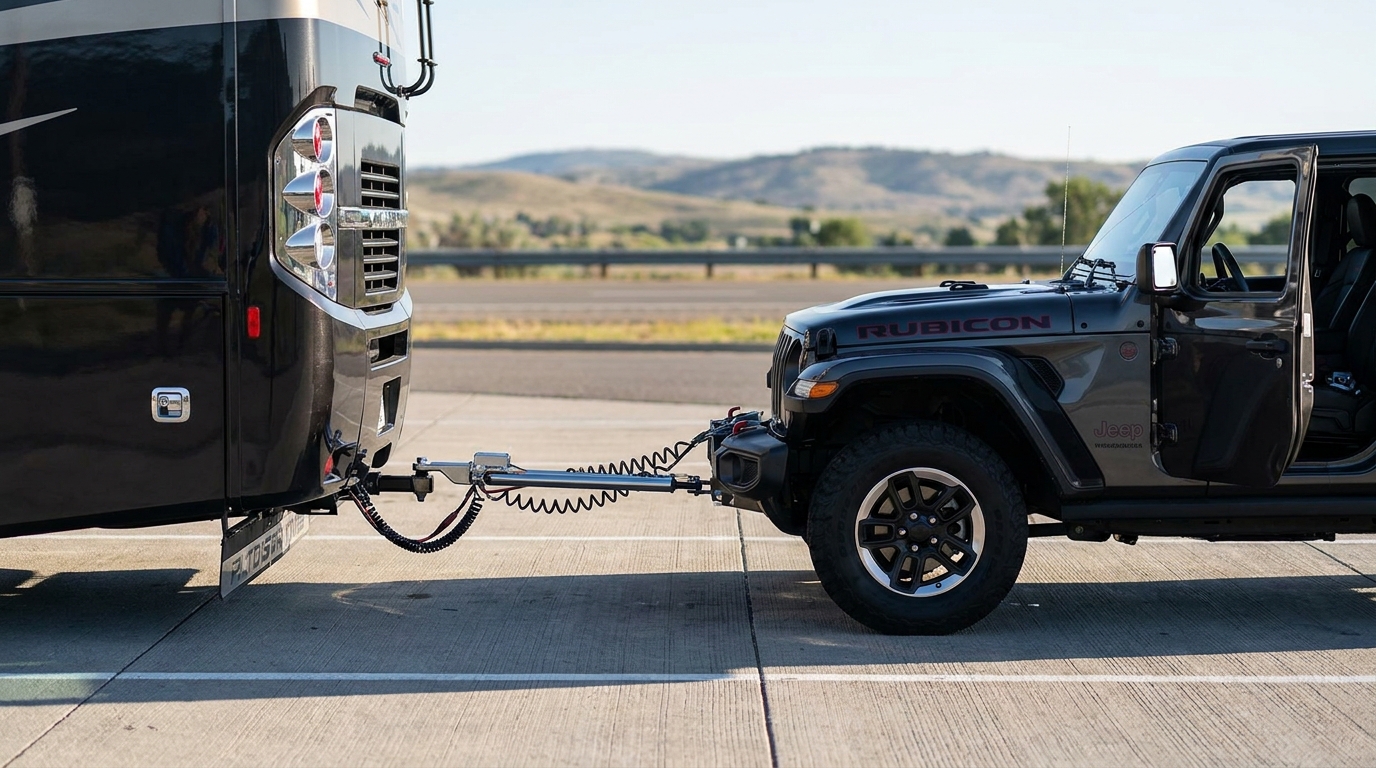
Unlike standard trailer hitches, a baseplate is a custom-engineered steel bracket system bolted directly to the subframe or unibody of your toad vehicle. It is hidden discreetly behind the front bumper, with removable safety tabs protruding through the grill mesh.
Key baseplate safety requirements mandated by SAE J684 standards:
- Subframe Mounting Torque: Bolts must be torqued to exact manufacturer specifications using red threadlocker (Loctite 271) to prevent loosening under highway vibration.
- Crossed Safety Cables: Dual high-tensile vinyl-coated steel safety cables must cross underneath the tow bar coupler to catch the tongue if a hitch disconnection occurs.
- Grade 8 Fasteners: Always ensure mounting hardware utilizes hardened Grade 8 bolts to withstand dynamic tongue shear loads during emergency stopping.
2. Tow Bars: Rigid Mechanical Coupling
The tow bar connects your motorhome’s 2-inch receiver hitch to the toad baseplate. Modern motorhome-mounted tow bars feature telescoping non-binding arms that lock automatically as you drive forward and release easily even on unlevel terrain.
“Never tow four-down without verifying that your tow bar is level within 3 inches of height variance between RV receiver and toad baseplate.”
3. Supplemental Auxiliary Braking Systems
Forty-nine US states and all Canadian provinces legally mandate auxiliary braking systems on towed vehicles over 3,000 lbs. Supplemental brakes activate the toad’s brake pedal proportionally when the RV brakes, drastically reducing stopping distance and preventing motorhome brake overheating in mountain passes.
Essential braking setup components include proportional brake actuators, diode tail light wiring harnesses, and an emergency breakaway switch that triggers full toad braking if hitch separation occurs.